Estepona | Costa del Sol
In Summary
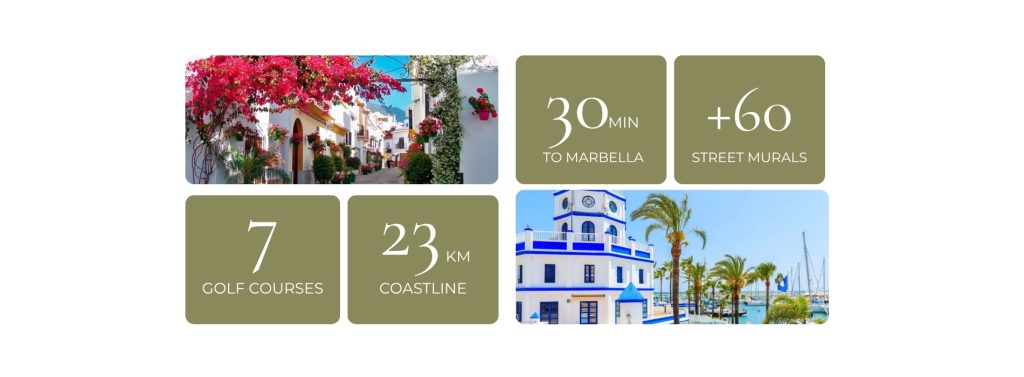
Estepona is one of the most authentic and fastest-growing towns in the province of Málaga. Located at the western end of the Costa del Sol, 30 minutes from Marbella and just over an hour from both Málaga and Gibraltar airports, it forms the well-known Golden Triangle together with Marbella and Benahavís. The town has grown without losing its Andalusian character, with a pedestrianised historic centre, flower-filled streets and a life of its own throughout the year.
Known as the Garden of the Costa del Sol, Estepona combines 23 kilometres of Mediterranean coastline with one of the best-kept historic centres in Andalusia. With more than 132 million euros in municipal investment in 2026 and a steady arrival of new international residents, Estepona is enjoying one of its strongest periods.
Explore the main areas and neighbourhoods of Estepona's urban centre on the map.
Explore the main areas and neighbourhoods of Estepona's urban centre on the map.
Estepona at a Glance
- What to expect: an authentic Andalusian town with a pedestrianised historic centre, wide beaches, a growing dining scene and strong municipal investment in urban improvements.
- The lifestyle: relaxed and rooted in local life, with year-round activity, neighbourhood markets, beach restaurants and a family-friendly atmosphere. Less showpiece than Marbella, more everyday living.
- What not to expect: the ostentatious luxury of Puerto Banús or the cosmopolitan atmosphere of the Golden Mile. Estepona favours a more understated form of elegance.
- The market: expanding rapidly. The range extends from apartments in the town centre to luxury villas on the New Golden Mile, with prices still below Marbella and strong appreciation.
- You will fall in love with: the flower-filled streets of the centre, the Senda Litoral, the Mirador del Carmen at sunset and the feeling of being somewhere genuinely authentic.
Location
Boundaries and accessibility
Estepona occupies the western end of the Costa del Sol, in the province of Málaga, with more than 23 kilometres of Mediterranean coastline. It borders Marbella to the east, via the New Golden Mile, Manilva to the west, the foothills of Sierra Bermeja to the north and the Mediterranean to the south, with views towards the Strait of Gibraltar and the African coast.
Its location is strategic. Well connected via the AP-7 toll motorway and the A-7 national motorway, Estepona is just over an hour from both Málaga and Gibraltar airports and only 30 minutes from central Marbella. It is also close to key destinations such as Puerto Banús, Sotogrande and the Hospital de Alta Resolución de Estepona, one of the most modern hospitals in Andalusia.
| Destination | Approximate travel time |
|---|---|
| Hospital de Alta Resolución de Estepona | 5 min |
| Puerto Banús | 20 min |
| Marbella centre | 30 min |
| Sotogrande | 30 min |
| Gibraltar Airport (GIB) | 45 min |
| Málaga Airport (AGP) | 55 min |
Lifestyle
Living in Estepona means discovering a slower, more authentic side of the Costa del Sol. The rhythm of an Andalusian town remains part of everyday life, with neighbours greeting each other in the square, weekly markets and a community that does not depend on tourism. At the same time, Estepona offers first-class dining, seven golf courses, kilometres of beaches and ongoing urban transformation. Daily life unfolds at street level, where both residents and visitors can easily find their place.
Historic centre and flower-filled streets
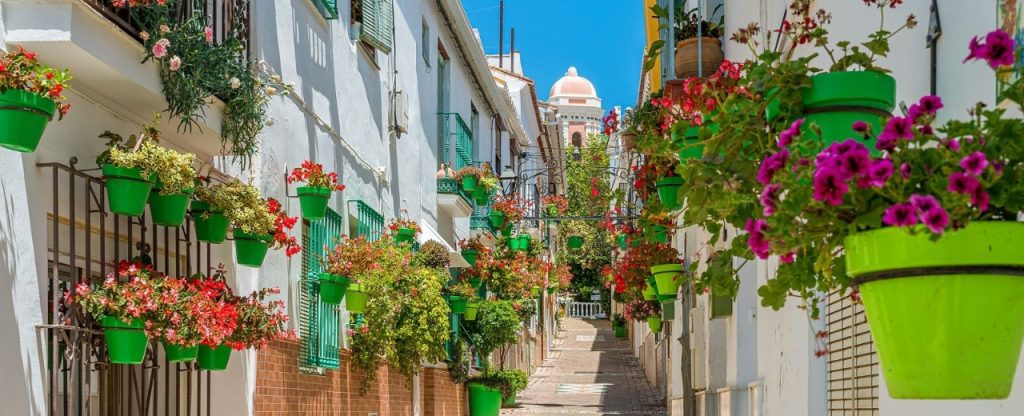
Estepona's old town is, by far, one of the best preserved and best maintained on the Costa del Sol. Its pedestrianised, whitewashed streets, decorated with thousands of colourful flowerpots, have earned the town the nickname "Garden of the Costa del Sol". The Plaza de las Flores is its social heart. Surrounded by terraces, palm trees and traditional buildings, it is a favourite meeting place for residents and visitors. Just a few steps away, the Artistic Murals Route features more than sixty large-scale works painted on façades throughout the centre, turning a walk through the town into an open-air gallery.
Seafront Promenade and Senda Litoral
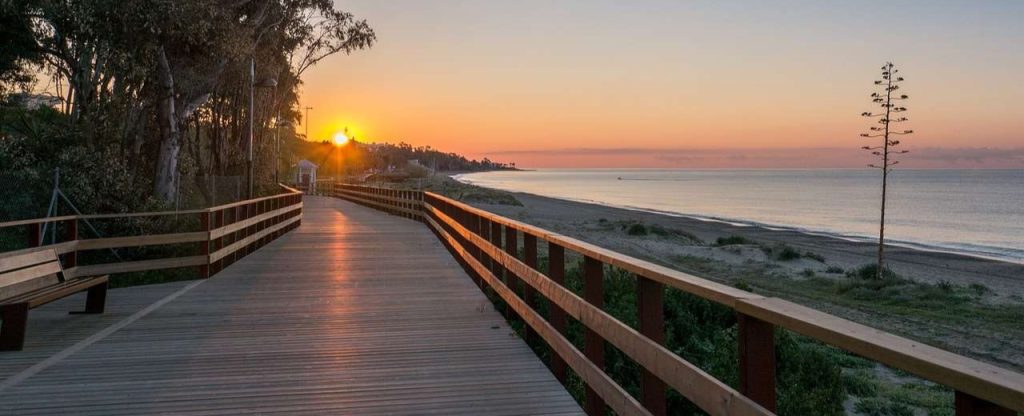
Estepona's seafront promenade is one of the most pleasant on the Málaga coastline. It is wide, tree-lined and includes fully pedestrianised sections connecting beaches, beach restaurants, restaurants and landscaped areas. It forms part of the Gran Senda Litoral de la Costa del Sol, a project by the Diputación de Málaga that will connect 180 kilometres of coastline from Manilva to Nerja. Estepona has already completed almost its entire section, allowing you to walk or cycle for several kilometres without leaving the municipality, always with the sea alongside you.
Bulevar Parque Central: the major urban transformation
Estepona is undergoing one of its most significant periods of transformation with the construction of the Bulevar Parque Central, a 17,3 million euro project that will redevelop 22.000 square metres between the new Town Hall, the seafront promenade and the town centre, with underground parking for more than 300 vehicles. The aim is to connect the seafront promenade with the historic centre through a large landscaped pedestrian corridor. Work is progressing well and, according to the Town Council, will represent "the culmination of a decade of urban transformation".
Gastronomy
Estepona's dining scene has grown enormously in recent years. Long-established neighbourhood taverns now sit alongside high-quality contemporary concepts, all within walking distance in the town centre. Some of the most recommended addresses include:
- Grupo De Miguel: Miguel Pérez's gastronomic project, with three neighbouring restaurants on Calle Caridad, Alma de Miguel (formerly Taberna de Miguel, known for fresh fish and market-led cuisine), La Marina de Miguel (tapas and dishes with a maritime character) and Taberna de Miguel (a classic tapas bar). Together, the three have become essential stops for anyone wishing to understand Estepona's evolving dining scene.
- Makako: Asian fusion cuisine on the top floor of Hotel El Pilar Andalucía, directly on Plaza de las Flores. Sushi, bluefin tuna tataki, Thai curry and one of the best terraces overlooking the old town.
- Las Gitanillas: Frank Chacón's restaurant, specialising in fresh fish from Estepona's fish market and vegetables from its own garden. Andalusian Mediterranean cuisine is served in an interior courtyard, accompanied by a carefully selected wine list.
- La Casa del Rey: a wine bar and gastrobar in a house with more than 200 years of history, just steps from Plaza de las Flores. It offers more than 120 wines, many available by the glass, and a creative tapas menu combining traditional flavours with international influences.
- La Bulla Gastrobar: located in Plazoleta Ortiz, facing the sea. It offers Mediterranean and Asian fusion cuisine, signature cocktails and one of the most sought-after terraces on the seafront promenade. It won the "Best Tapa" competition in Estepona's Ruta de la Tapa.
Marina
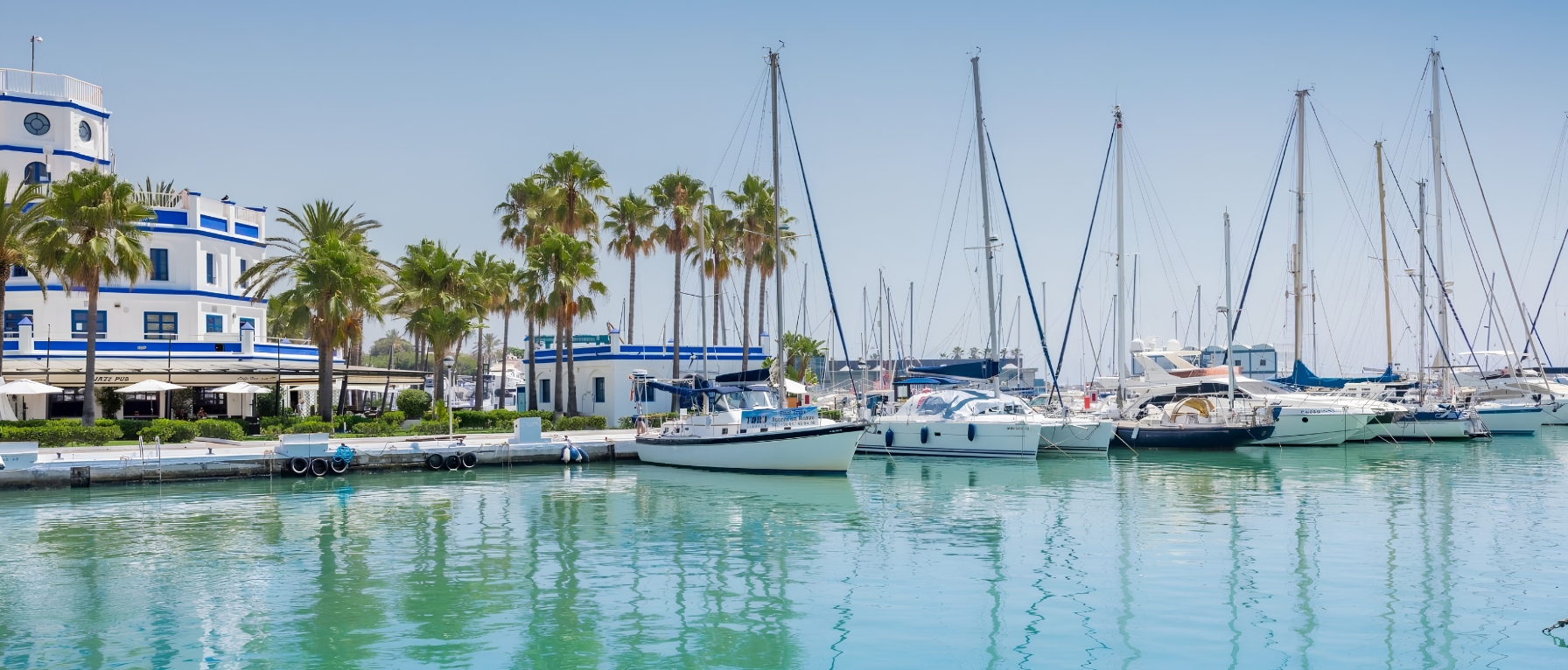
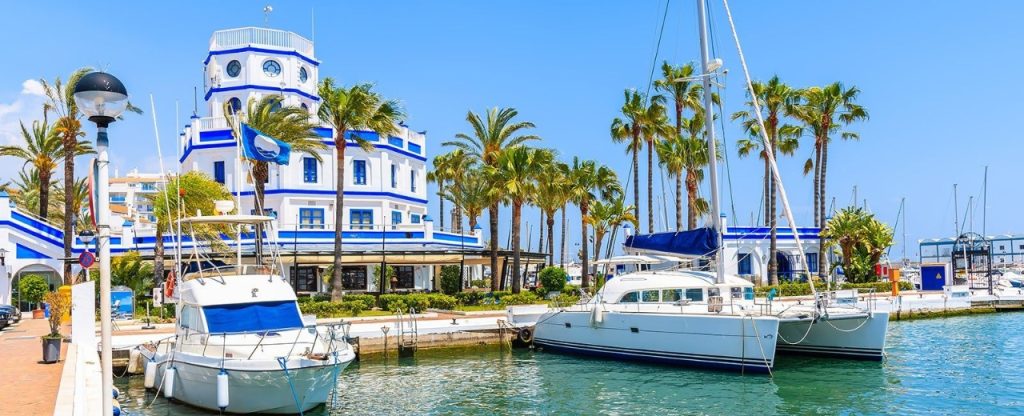
The Estepona Marina is one of the liveliest areas in the municipality. With 447 berths, it accommodates everything from small leisure boats to larger yachts and offers a wide selection of restaurants, bars and nightlife. It is also one of the main departure points for whale and dolphin watching trips, which are common in the waters off Estepona.
Beaches
Estepona has more than 23 kilometres of coastline and around twenty beaches, most with golden sand and all with Blue Flags or quality certifications. Some of the best known include Playa de la Rada (the urban beach beside the seafront promenade), Playa del Cristo (a small, sheltered and very family-friendly cove), as well as the beaches of El Padrón , Guadalmansa and El Saladillo, towards Marbella, which are wider and less developed. On clear days, the African coastline and the Rock of Gibraltar are clearly visible.
Golf
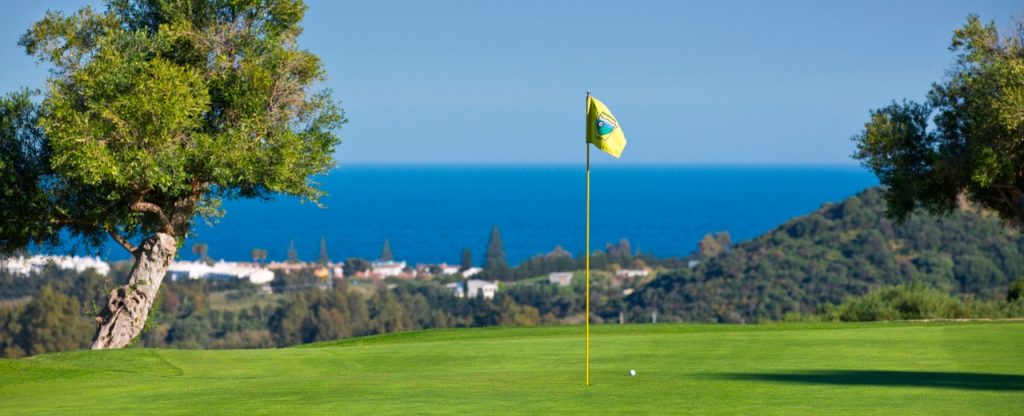
Estepona is one of the municipalities with the highest concentration of golf courses on the Costa del Sol. It has seven courses within the municipality, with options for every level:
- Atalaya Golf & Country Club: two 18-hole courses, Old Course and New Course, designed in the 1960s and 1970s. It is one of the area's oldest and most prestigious clubs.
- Valle Romano Golf & Resort: 18 holes designed by Cabell B. Robinson between the sea and the mountains, with Mediterranean views from almost every fairway.
- Estepona Golf: 18 holes designed by José Luis López in 1989, with Sierra Bermeja and the Mediterranean as a backdrop.
- El Paraíso Golf Club: designed by Gary Player in 1973, one of the municipality's most established courses.
- Azata Golf: 18 holes beside Estepona's western coastline, with a varied layout and attractive pricing.
- La Resina Golf and El Campanario Golf: two 9-hole courses, ideal for shorter rounds and for those starting out in the game.
Fifteen minutes away, just outside the municipality but an essential reference point, is Finca Cortesín, host of the Solheim Cup 2023 and one of the most prestigious golf courses in Europe.
Families, market and viewpoints
Estepona is a very family-friendly destination. Its pedestrianised squares, children's parks and calm atmosphere make daily life with children straightforward. The Mercado Municipal de Abastos, in Plaza de Santa Ana, is an essential stop. Recently renovated, it combines traditional fish, meat and vegetable stalls with a food area where you can enjoy tapas at weekends. On the seafront promenade, the tower of the Mirador del Carmen offers one of the best panoramic views of the town and the Mediterranean at sunset. For family afternoons, the Estepona Orchidarium , the largest in Europe, is a must-visit.
Nearby schools
Estepona has a good selection of public and semi-private schools, as well as several leading international schools just a few minutes from the town centre:
- Mayfair International Academy (Estepona): a private British school following the UK curriculum, highly sought after by international families.
- Atalaya British International School (Estepona): a British school offering education from Early Years through to Sixth Form.
- Laude San Pedro International College (20 min away): located in San Pedro de Alcántara, with British and international programmes.
You can consult our Guide to Schools in Marbella for more information about educational options in the area.
The Market
Estepona is experiencing one of the most dynamic periods in its property market. Strong municipal investment in urban improvement, the steady arrival of international buyers and an increasingly diverse supply, from apartments in the town centre to luxury villas on the New Golden Mile, have positioned it as one of the most attractive alternatives on the Costa del Sol. Prices remain noticeably below Marbella, although the gap is narrowing year by year.
Property profile
Estepona offers a very varied range of property, setting it apart from more homogeneous areas such as the Golden Mile or Sotogrande. In the town centre apartments and penthouses predominate, many in newly built or recently refurbished buildings. In the coastal area, particularly to the east (New Golden Mile, El Paraíso, Selwo, Cancelada), there is a concentration of detached villas, townhouses and gated developments with communal pools and golf courses. To the west (Bahía Dorada, Costa Galera, Buenas Noches), more affordable residential complexes with a holiday-home profile predominate. In the upper area (Valle Romano, Reinoso, La Resina), the number of villas with sea and Sierra Bermeja views is growing.
Supply and inventory
Estepona is, by far, the municipality with the largest volume of new-build developments being marketed on the Costa del Sol. According to the main property portals, more than 150 active developments are currently being marketed within the municipality alone. This breadth of supply creates a wide range of prices and property profiles, from two-bedroom apartments around 300.000 € to luxury frontline beach or golf villas exceeding 5 million.
Prices and values (2026)
According to the latest data from idealista, the average property price in Estepona stands at 4.307 €/m² (May 2026), representing a year-on-year increase of 11,6%. In the luxury new-build segment, prices can reach 7.000 €/m² in the most exclusive areas, according to analysis published by idealista/news.
The comparison with Marbella is particularly relevant. In the neighbouring town, the average price is around 5.500 €/m², placing Estepona approximately 20% lower. Yet Estepona's rate of growth is considerably higher, narrowing that gap each year.
New Build
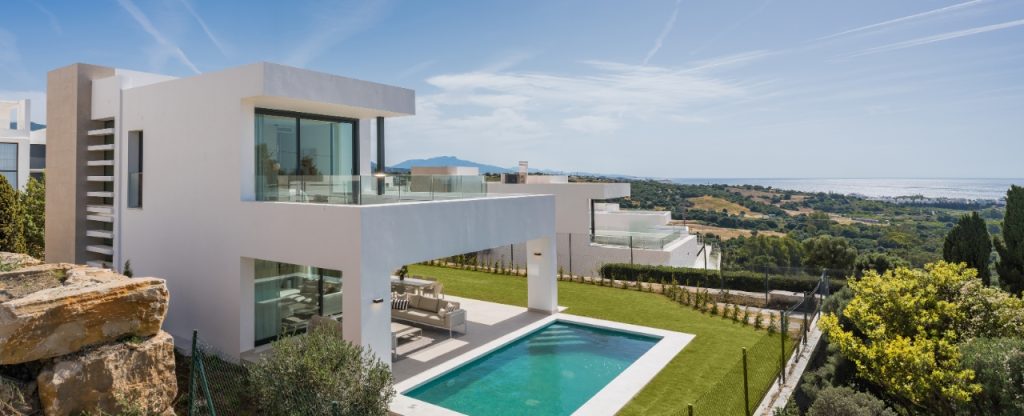
Among Estepona's current new-build offering, one development stands out: Aurea Villas, an exclusive development marketed by Marenco Real Estate. It is a collection of just 10 luxury villas on the frontline of Estepona Golf, with panoramic views of the Mediterranean, the golf course and Sierra Bermeja. Each villa offers more than 400 m² built on 756 m² plots, arranged over two floors plus a customisable basement, with a private garden and pool. Specifications include Miele appliances, a BORA hob with integrated extractor, underfloor heating, Daikin Altherma climate control and pre-installation for home automation. Prices start from 1,4 million euros, with completion scheduled for the last quarter of 2026.
Buyer profile
International buyers are a major driver of Estepona's market and represent a growing share of total demand. British buyers have historically led the market, followed by Belgian, Dutch, German and Nordic buyers. In recent years, the presence of buyers from the United States, France and Eastern Europe has increased significantly. They are attracted by both the lifestyle and prices that remain competitive compared with other Mediterranean destinations such as the French Riviera or Portugal. The most common motivations are personal use as a second home, relocation by international families seeking quality of life and schools, and long-term property investment in a market perceived to be at an early stage of appreciation.
Rental market and returns
Holiday rentals perform well in Estepona, particularly in coastal areas and the town centre. Gross yields generally range between 4% and 6% annually, depending on location and property type, with higher peaks for well-located and well-managed apartments. As elsewhere in the province of Málaga, it is essential to verify the tourist licence and the rules of the owners' association before investing for rental purposes.
Trends
All indications suggest that Estepona will remain one of the most dynamic markets on the Costa del Sol in the coming years. Three factors support this outlook: record municipal investment of 132 million euros in 2026, with 35 million allocated to maintenance and urban aesthetics; the arrival of major new hotel and residential projects on the New Golden Mile and surrounding areas; and the spillover effect from Marbella, where the market is almost saturated in the most exclusive locations, pushing buyers towards Estepona. For those considering the Costa del Sol for investment or relocation, Estepona currently offers an opportunity that may not remain available at today's prices for much longer.
Origins
From the Phoenicians to Rome
Estepona's origins date back almost three thousand years, when the Phoenicians established the first settlements along its coastline, attracted by fishing and its strategic position on the maritime route between Cádiz and Málaga. Ceramic remains and the foundations of several watchtowers survive today around the Vaquero, Guadalmansa, Padrón and Velerín streams. The Romans arrived later and occupied the area extensively. At the mouth of the Guadalmansa River, the remains of thermal baths survive that may have belonged to the ancient Roman city of Salduba, one of the most important settlements on the western Málaga coast during the Roman Empire.
Al-Estebbuna: the origin of the name
With the arrival of the Muslims in the 8th century, the area developed around two fortresses: Castillo del Nicio, in the upper part of El Padrón, and, by the 10th century, the fortress of Al-Estebbuna, built during the caliphate of Abderramán III on the site of today's town centre. This is the first documented appearance of the place name that would later give the town its name. Over the following centuries, Estepona functioned as a defensive enclave and a small port town of al-Andalus, with fishing and agricultural activity.
Reconquest and independent town
In 1456, King Enrique IV of Castile conquered Estepona. Its proximity to the still-standing Nasrid Kingdom of Granada led to the destruction of much of the town to prevent it from serving as a refuge for Muslim armies. After the fall of Granada in 1492, the Catholic Monarchs ordered Christian resettlement and the construction of the Castillo de San Luis, a bastioned fortress built at the end of the 16th century to defend the coast against raids by Barbary pirates. In 1729, King Felipe V granted Estepona administrative independence from Marbella, a key moment in its consolidation as an independent town.
18th and 19th centuries: a fishing and agricultural town
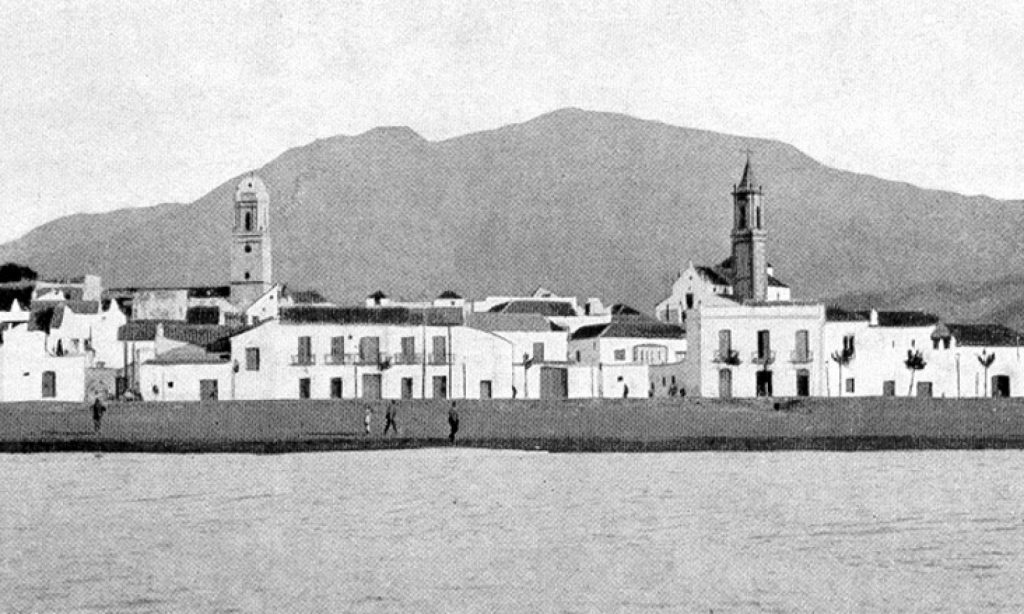
Over the next two centuries, Estepona remained a quiet coastal town devoted to fishing, agriculture and small-scale trade. Buildings were erected that still survive today, such as the Iglesia de la Virgen de los Remedios (18th century), in Plaza de San Francisco, and the Casa de los Marqueses de Mondéjar, from the same century. Fishing shaped the rhythm of the town, with a fleet leaving Playa de la Rada every day and social life centred around the square and the parish church.
The rise of tourism
Tourism began to take off in the 1960s, as it did across much of the Costa del Sol, although at a much slower pace than in Marbella or Torremolinos. This slower growth is precisely what allowed Estepona to preserve much of its Andalusian town identity. Coastal developments and the first golf courses began to appear in the 1970s and 1980s, while the town centre retained its traditional layout.
The major urban transformation
The most profound change has taken place over the last two decades, driven by strong municipal investment in pedestrianising the centre and creating the Artistic Murals Route , with more than sixty large works painted on façades, the restoration of squares and gardens, and the transformation of the former N-340 into a large pedestrian boulevard facing the sea. Today, the Bulevar Parque Central will complete this transformation by permanently connecting the historic centre with the seafront promenade. This combination of preserved history and well-considered modernity helps explain Estepona's current appeal.
Fun Facts
The city of murals
Estepona has more than 60 giant murals across façades throughout the municipality as a result of the municipal "Museo al Aire Libre" initiative. One of the most notable is "Día de Pesca" by artist José Fernández Ríos, considered the largest vertical mural in Spain with more than 1.000 square metres and a height of six storeys.
Europe's most important orchidarium
The Parque Botánico Orquidario houses the largest collection of orchids in Spain and one of the most important in Europe, with more than 1.500 species and 5.000 specimens. It is protected by three glass domes, the largest measuring 30 metres high. Some of its orchids release unusual scents, such as coconut or white chocolate, and the well-known "corpse flower" bloomed here for the first time in Spain.
Independent since 1729
Until the 18th century, Estepona formed part of Marbella's jurisdiction. It was King Felipe V who granted it administrative independence as a town in 1729. Almost 300 years later, that distinct identity remains one of the defining aspects of its character.
A town council with record figures
Estepona has undergone a notable economic transformation. It cleared inherited debt of more than 300 million euros, closed 2024 with a record surplus of 45 million and pays its suppliers in just 12 days. For 2026, the Town Council approved the highest budget in its history: 132 million euros.
One of the longest seafront promenades in Spain
What until a few decades ago was the urban section of the former N-340 road is now a pedestrian boulevard almost 2 kilometres long facing the sea. Considered one of the longest seafront promenades in the country, it is one of the most frequently cited examples of the town's urban transformation.
The Spanish firs of Sierra Bermeja
The Sierra Bermeja, which rises directly behind Estepona, contains one of the world's last forests of Spanish firs , a species of fir that grows only in this part of Andalusia and the neighbouring Sierra de Grazalema. From Pico de los Reales (1.449 metres), the entire African coastline and the Rock of Gibraltar can be seen on clear days.
Frequently Asked Questions
Where is Estepona located?
Estepona is located at the western end of the Costa del Sol, in the province of Málaga, 30 minutes from central Marbella, 55 minutes from Málaga Airport and 45 minutes from Gibraltar Airport. Together with Marbella and Benahavís, it forms the well-known Golden Triangle.
What types of properties can you find in Estepona?
The range is very broad: apartments and penthouses in the town centre and along the coast, detached villas in developments such as Estepona Golf, Valle Romano, El Paraíso or Los Flamingos, townhouses in gated complexes, as well as luxury frontline beach or golf villas. Estepona is one of the municipalities with the widest variety of property types and prices on the Costa del Sol.
What are the approximate property prices?
The average price in Estepona stands at 4.307 €/m² (May 2026), although it varies considerably by area and property type. Two-bedroom apartments start at around 300.000 €, detached villas generally range between 800.000 € and 2 million, while luxury villas can range from 3 to more than 8 million. High-end new-build property can exceed 7.000 €/m² in the most exclusive areas.
Is Estepona a good area for families with children?
Yes, it is one of the most suitable options on the Costa del Sol for families. It has a very safe pedestrianised town centre, wide Blue Flag beaches, children's parks, an excellent Hospital de Alta Resolución and several international schools within the municipality (Mayfair, Atalaya British International) and nearby (Laude San Pedro).
What distinguishes Estepona from Marbella?
Estepona offers a more authentic and relaxed experience, with a well-preserved pedestrianised historic centre, flower-filled streets and year-round local life. Marbella is more cosmopolitan and offers more ostentatious luxury, while Estepona favours more understated elegance, with prices approximately 20% lower and greater potential for appreciation.
What is the cultural and leisure scene like?
Very active throughout the year. Estepona has more than 60 artistic murals, the largest orchidarium in Europe, an auditorium theatre, a renovated municipal market, a marina with nightlife, more than 20 beaches and a broad dining scene ranging from traditional taverns to high-quality fusion cuisine.
How many golf courses are there in Estepona?
Estepona has seven golf courses within the municipality: Atalaya Golf (36 holes), Valle Romano, Estepona Golf, El Paraíso, Azata Golf, La Resina and El Campanario. In addition, Finca Cortesín, host of the Solheim Cup 2023, is 15 minutes away.
Is buying in Estepona a good investment?
Yes. Prices have been rising at double-digit rates for several years, and all indications suggest the trend will continue: municipal investment is at a record level (132 million in 2026), the luxury hotel and residential offering continues to grow, and the market is still considered to be at an early stage of appreciation compared with Marbella. In addition, holiday rental yields generally range between 4% and 6% annually.
Can properties be rented for holiday use?
Yes, although as elsewhere in Andalusia it is essential to obtain the relevant tourist licence and verify that the rules of the owners' association permit this use. In areas such as the town centre, the seafront promenade and the areas around golf courses, demand for holiday rentals is very high.
What are healthcare services like in Estepona?
Estepona has the Hospital de Alta Resolución de Estepona, one of the most modern hospitals in Andalusia, as well as a broad network of private clinics. Hospital Costa del Sol (Marbella) is 20 minutes away, and multilingual medical services aimed at international residents are available throughout the area.
Living in Estepona means choosing a slower, more authentic and more human side of the Costa del Sol. It is a place where the historic centre remains the true heart of the town, neighbours greet one another in the street, neighbourhood markets coexist with high-quality restaurants, and fishing boats return to the port every morning as they have done for centuries. All of this is just minutes from Marbella, Sotogrande and the international airports of Málaga and Gibraltar.
We invite you to discover our portfolio of properties in Estepona and allow our team to guide you in the search for your next home on the Costa del Sol.

